
Baby (0–12 months)Free — baby's first 3 months
Month 1: Eye Contact & First Tummy Time
This activity encourages early bonding and sensory exploration during your baby's first month, focusing on visual tracking and gentle movements.
Ready right nowNo materials needed ✨ 5 min Ages 0–1 months 1–2 players Indoor
Visual tracking (following objects)Head turning (early motor control)Auditory discrimination (responding to voices)Social engagement (eye contact, facial recognition)Sensory awareness (touch, sight, sound)
Materials
Setup
- 1Ensure the room is quiet, calm, and well-lit with indirect light. Lay a firm play mat or clean blanket on the floor away from drafts. Make sure the space is free of hazards and pets.
Step-by-step instructions
- MILESTONES THIS MONTH: Around month 1, many babies briefly lift their heads while on their tummy, focus on faces, prefer black-and-white or high-contrast patterns, keep their hands in tight fisted positions, and react to loud sounds. They begin to turn their heads towards sounds and voices, and may make small, jerky arm and leg movements.
- WHEN TO CALL YOUR PEDIATRICIAN: If your baby is not feeding well, seems unusually floppy or stiff, doesn't respond to loud noises, has unusually pale or jaundiced skin, or doesn't make any eye contact with you. Persistent fussiness or extreme lethargy also warrants a call to your pediatrician.
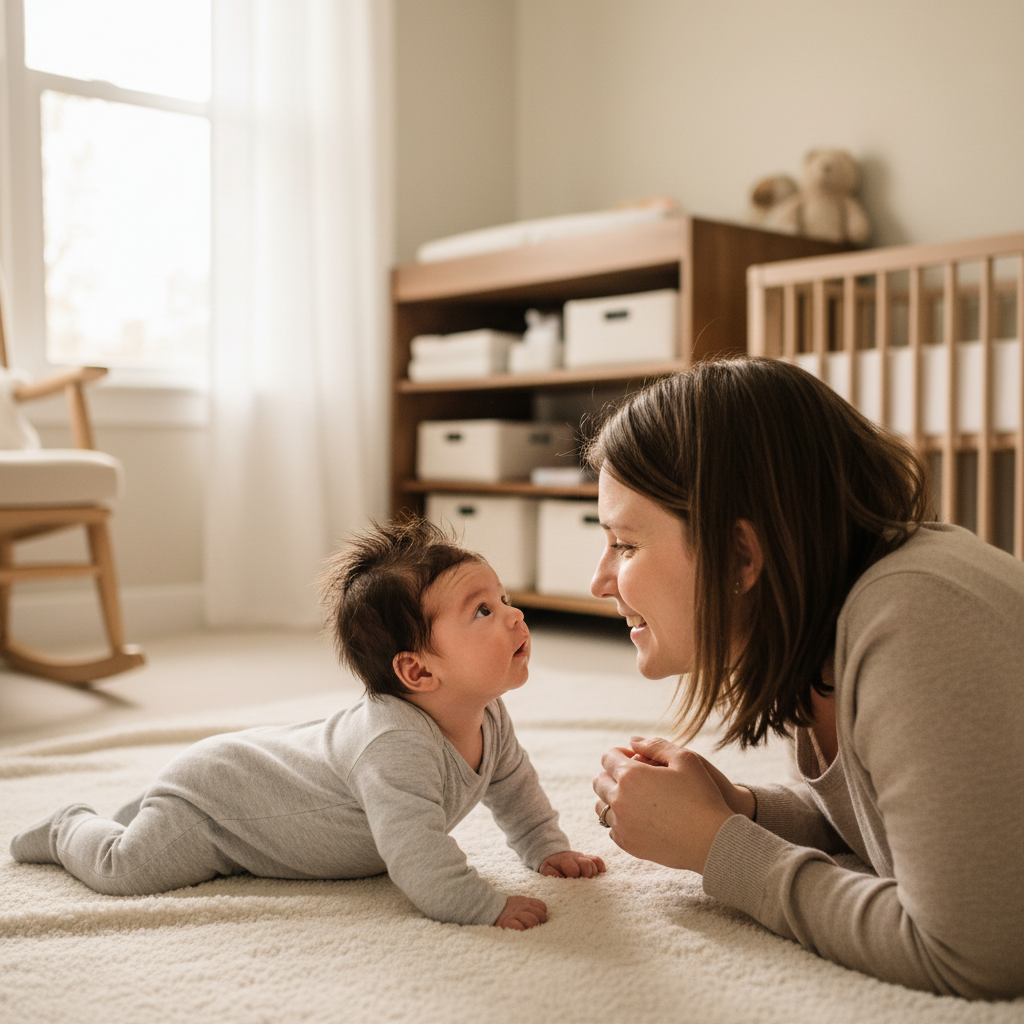
- HOW TO SET UP THE ACTIVITY: Lay your baby on their stomach on the firm play mat. Lie down facing them, ensuring your face is about 8-12 inches (20-30 cm) from theirs. Ensure their arms are tucked close to their body, enabling better head lift. Keep the session very short, just a minute or two at a time.
- STEP-BY-STEP CAREGIVER MOVE #1: Gently place the high-contrast board book flat on the mat directly in front of your baby's face, about 8-12 inches away. Slowly move the book in an arc from one side to the other, encouraging their eyes to track the movement. Narrate, saying, 'Look at the stripes! They're moving! Can you see them?'
- CAREGIVER MOVE #2: After they’ve tracked the book, place it aside. Bring your face close to theirs and make slow, exaggerated facial expressions. Smile, widen your eyes, and then narrow them. Say softly, 'Hello, baby! I see you!' or sing a gentle song. This encourages eye contact and facial recognition.
- CAREGIVER MOVE #3: While still in the tummy time position, gently shake the soft rattle slightly off to one side of their head, just within their peripheral vision, about 10-12 inches away. See if they turn their head towards the sound. If they do, bring the rattle into their field of vision and say, 'Did you hear that sound?'
- READ BABY'S CUES: Look for signs of engagement: wide eyes, focused gaze, quiet alertness, small head lifts. If your baby fusses, turns their head away, arches their back, or closes their eyes tightly, they may be overstimulated or tired. Immediately stop the activity, offer a comforting cuddle, or move to a quiet rest time.
- HOW TO WEAVE THIS INTO DAILY ROUTINES: Incorporate brief tummy time sessions on the changing table after a diaper change. While feeding, make eye contact and talk softly. During bath time, narrate your actions. When holding your baby, sing lullabies and describe what you see, reinforcing language exposure.
Example playthrough
"During month 1, Sarah gently lays her baby Leo on the play mat for a minute of tummy time. She gets down on the floor to meet his gaze. Leo briefly lifts his head and makes eye contact with Sarah as she slowly moves a high-contrast book in front of him, saying, 'You’re looking at the big circles, Leo! So strong!'"
Variations
- ✨ Sibling-involved version: An older sibling can sit near the mat and softly talk or sing to the baby during tummy time, supervised by a parent.
- ✨ Low-energy caregiver: Hold your baby upright against your chest while softly humming or singing, swaying gently to provide sensory input.
- ✨ Upright visual stimulation: While holding your baby in your lap, show them the high-contrast book, slowly moving it from side to side in their line of sight.
Learning benefits
- 💡 This activity promotes early visual development and encourages your baby to practice focusing and tracking, essential for cognitive growth. It also fosters secure attachment through responsive 'serve and return' interactions and provides crucial early exposure to language and sound perception.
Safety notes
- ⚠️ Always supervise tummy time closely • Place baby on their back to sleep, never on their tummy • Ensure all materials have no small parts and are well beyond curious mouths • No screens for babies under 18 months, except live video chat for families • No loose blankets or soft bedding in the sleep space.
Cleanup
- 🧹 Put materials away in their designated place.
From the community (0)

Loved it? Let other families know
Everything is optional — leave a star, a tip, a photo, or all three.
Loading your feedback…