
Baby (0–12 months)Free — baby's first 3 months
Month 3: High-Contrast Visual Tracking
This month focuses on refining visual tracking, strengthening neck and upper body muscles, and encouraging social interaction as your baby becomes more aware of their surroundings.
Ready right nowNo materials needed ✨ 10 min Ages 2–3 months 1–2 players Indoor
Visual tracking (following objects with eyes)Head control (lifting head 45-90 degrees during tummy time)Reaching and swiping at objectsCooing and making vowel soundsSocial smiling and recognizing familiar facesSensory exploration (focusing on patterns and colors)
Materials
Setup
- 1Prepare a quiet, well-lit space on the floor. Lay down a firm play mat or blanket. Ensure all materials are clean, easily accessible, and free of small parts.
Step-by-step instructions
- MILESTONES THIS MONTH: Around month 3, many babies lift their head and chest when on their tummy, push down on their legs when feet are on a hard surface, open and shut their hands, bat at dangling toys, follow moving objects with their eyes, recognize familiar people and objects at a distance, smile at sounds, coo, vocalize in different ways to express feelings, and respond to social interaction. Remember, every baby develops at their own pace.
- WHEN TO CALL YOUR PEDIATRICIAN: Contact your pediatrician if your baby doesn't seem to recognize familiar people, doesn't try to get your attention through movement or sounds, doesn't follow moving objects with their eyes, or doesn't smile at people during interaction. Early intervention can make a significant difference.
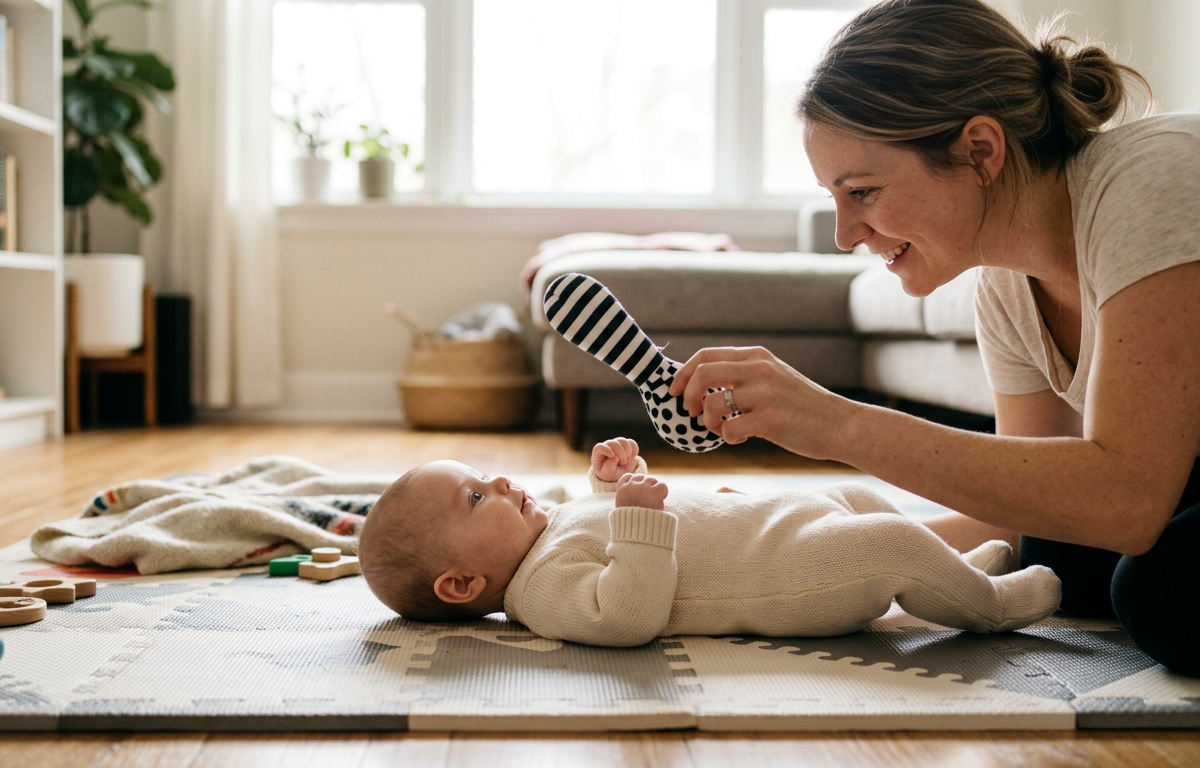
- HOW TO SET UP THE ACTIVITY: Place your baby on a firm play mat on their back or, for a short period, on their tummy (ensure they are awake and supervised). Position yourself close to your baby, ensuring good eye contact. Hold the high-contrast item about 8-12 inches from their face.
- STEP-BY-STEP CAREGIVER MOVE #1: Gently move the high-contrast item slowly from one side of your baby's midline to the other, encouraging their eyes to follow. Verbally engage with them, saying, 'Look, baby! Can you see the stripes go side to side?' Observe their focus and eye movements. Keep the movement smooth and continuous.
- CAREGIVER MOVE #2: After they track horizontally, try moving the item slowly in a vertical direction (up and down), saying, 'Now the circles are going up! And now they're going down!' This helps develop their vertical tracking. Pause periodically to let them rest their eyes on the object.
- CAREGIVER MOVE #3: Incorporate a soft rattle or cloth toy. Hold it within reach, slightly above their chest, and gently shake it to grab their attention. Encourage them to bat or swipe at it. Say, 'Can you reach the rattle? Kick, kick, kick!', reinforcing their emerging hand-eye coordination.
- READ BABY'S CUES: Look for signs of engagement like wide eyes, focused gaze, cooing, or smiling. If your baby turns their head away, grimaces, arches their back, or becomes fussy, they might be overstimulated or tired. Give them a break, reposition them, or offer a comforting cuddle.
- HOW TO WEAVE THIS INTO DAILY ROUTINES: During diaper changes, hold a high-contrast item above them and move it slowly as you talk to them. When feeding, use parentese to narrate what you're doing, varying your tone. Incorporate very short bursts of tummy time (3-5 minutes) several times a day, placing stimulating toys just out of reach.
Example playthrough
"Javier, 3 months old, is on his tummy. His dad, Marco, holds up a black-and-white striped card. Marco slowly moves the card from left to right, saying, 'Here come the stripes, Javier! Look at them zoom!' Javier's eyes widen, and his head follows the card with increasing steadiness, occasionally letting out a happy gurgle."
Variations
- ✨ Sibling included: An older sibling can hold the high-contrast item (under direct adult supervision), moving it slowly and talking to the baby, fostering early sibling bonding.
- ✨ Low-energy caregiver: Lay side-by-side with your baby and hold the high-contrast item, moving it from your chest area to slightly above your baby's head, verbally narrating its movement.
- ✨ Second caregiver bonding: One caregiver can hold the visual aid and engage the baby, while the second caregiver sits behind the baby, offering gentle support for tummy time or making comforting sounds.
Learning benefits
- 💡 Visual tracking activities at this age foster cognitive development, improving eye muscle control and depth perception. Early language exposure through consistent narration and parentese is crucial for building foundational language skills and promoting secure attachment through responsive interaction.
Safety notes
- ⚠️ Always place baby on their back to sleep on a firm, flat surface • Tummy time should always be supervised and baby must be awake • No small parts that could be a choking hazard • No screens for babies under 18 months, except for live video chat with family • Never leave baby unattended, especially on elevated surfaces.
Cleanup
- 🧹 Put materials away and ensure the play area is clear.
From the community (0)

Loved it? Let other families know
Everything is optional — leave a star, a tip, a photo, or all three.
Loading your feedback…