
Pip Playbook fox mascotPip Sign in

Try Pip Plus free for 7 days

$9.99/mo or $59.99/yr · planner, milestones & full library

Month 4: Reach, Grab & Roll Practice — Baby (0–12 months) activity for ages 3–4 months (indoor, 10 min)
Baby (0–12 months)Free — baby's first 3 months

Month 4: Reach, Grab & Roll Practice

This activity encourages your 4-month-old to explore their hands, reach for objects, and start practicing the early movements towards rolling, fostering curiosity and motor development.

Ready right nowNo materials needed ✨ 10 min Ages 3–4 months 1–2 players Indoor
Improved head control and stability during tummy timeReaching and batting at dangling objectsBringing hands to midline and grasping objectsVocalizing more distinctly (cooing, babbling)Tracking moving objects with eyesBeginning to initiate rolling from tummy to back or back to side

Materials

Setup

  1. 1Prepare a safe, clear space on a firm play mat or blanket on the floor. Ensure the area is well-lit and free from drafts or distractions. Place the baby on their back initially, then transition to a supervised tummy time position.

Step-by-step instructions

  1. 1MILESTONES THIS MONTH: Around month 4, many babies are gaining better head control, starting to push up on their elbows during tummy time, reaching for toys with both hands, bringing hands to mouth, and beginning to babble or coo more intentionally. They often smile spontaneously, laugh, and show excitement.
  2. 2WHEN TO CALL YOUR PEDIATRICIAN: Act early if your baby doesn't respond to loud sounds, doesn't bring objects to mouth, doesn't push down with legs when feet are placed on a firm surface, has trouble moving one or both eyes in all directions, or doesn't babble or make a variety of sounds.
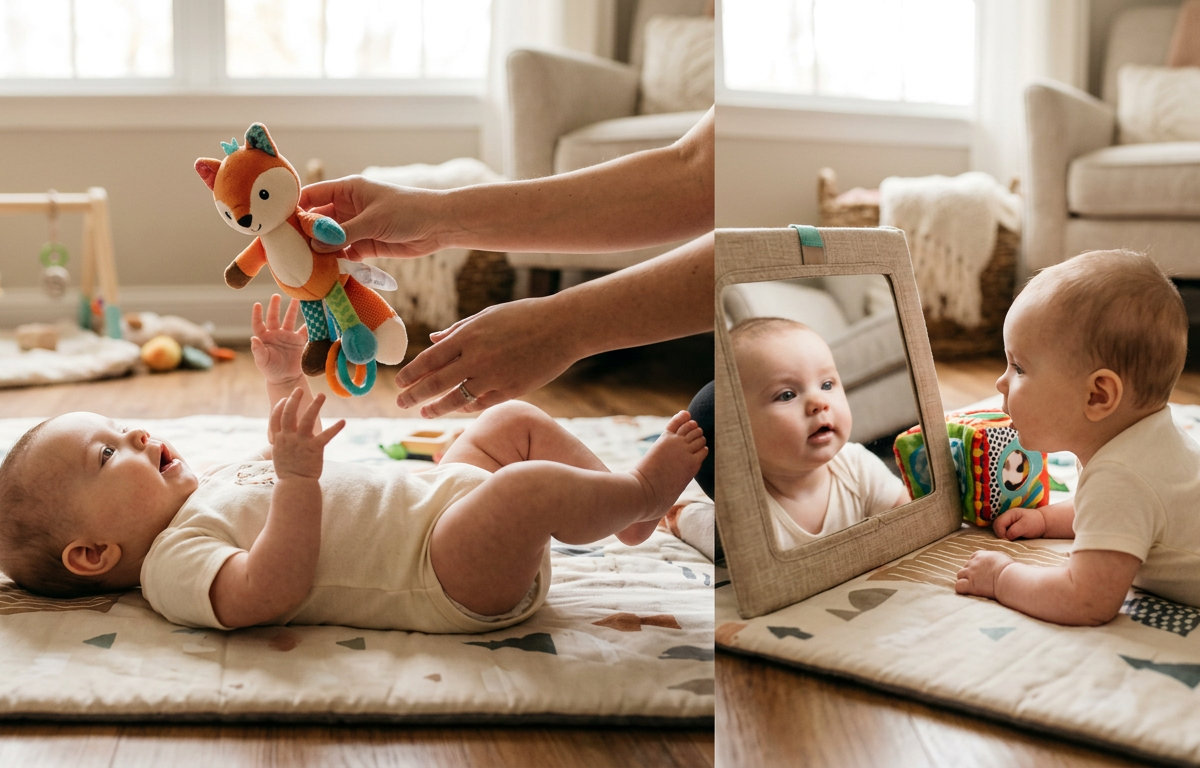
  3. 3HOW TO SET UP THE ACTIVITY: Lay your baby on their back on the firm play mat. Ensure your face is illuminated and close to theirs to encourage eye contact and communication. Have the soft rattle and crinkly toy within easy reach for you to offer.
  4. 4CAREGIVER MOVE #1: Start with baby on their back. Hold the soft rattle just above their chest, about 6-8 inches away. Gently move it side to side, encouraging their eyes to track it. Say, 'Look at the rattle, can you see it move?'
  5. 5CAREGIVER MOVE #2: As baby tracks the rattle, slowly lower it towards their chest and just outside their reach. Jiggle it gently. Narrate, 'You're reaching for it! See your hands?' Encourage them to swat or reach out. If they grasp it, offer praise.
  6. 6CAREGIVER MOVE #3: Place your baby on their tummy on the mat. Position the baby-safe mirror directly in front of them at eye level. Lay the crinkly toy slightly to one side of their head, encouraging them to turn and reach. 'Who's that in the mirror? Look at this fun toy! Can you reach it?'
  7. 7READ BABY'S CUES: Look for signs of engagement like smiling, cooing, reaching, and sustained eye contact. If they arch their back, turn their head away, fuss, or become limp, they may be overstimulated or tired. Respond by taking a break, holding them close, or moving to a calmer activity.
  8. 8HOW TO WEAVE THIS INTO DAILY ROUTINES: During diaper changes, gently tickle your baby's feet and tummy with a soft toy or your hand, narrate what you're doing, and make eye contact. During feeding, hold a small, soft toy near their hand to encourage reaching and grasping when not actively feeding. Incorporate short bursts of supervised tummy time on the floor after each wake window.

Example playthrough

"Caregiver Alex sits on the floor with 4-month-old Maya on a play mat. Alex holds a soft rattle, shaking it gently while saying, 'Want the rattle, Maya? Look!' Maya tracks it with her eyes, then bats at it with one hand, letting out a joyful squeal. Alex praises her, 'Good job, you got it!' and helps her grasp the rattle."

Variations

  • For siblings, the older child can lie on their tummy opposite the baby, encouraging the baby to lift their head and engage face-to-face.
  • For a low-energy caregiver, simply lie next to your baby on the mat, offering a soft toy within reach and narrating softly while maintaining eye contact.
  • A second caregiver can sit behind the baby during tummy time, offering support to their hips to help them push up, while the first caregiver engages the baby from the front with toys.

Learning benefits

  • 💡 This activity supports the development of gross motor skills through tummy time and reaching practice, fine motor skills through grasping, and cognitive development through tracking and object exploration. Narrating and responding to baby's cues fosters language acquisition and secure attachment through serve-and-return interactions.

Safety notes

  • ⚠️ Always supervise tummy time; place baby on their back to sleep every time, even for naps • Ensure all toys are age-appropriate, larger than a golf ball, and free of small parts to prevent choking hazards • Never leave baby unattended on elevated surfaces, and always stay within arm's reach • No screen time for babies under 18 months, except for live video chat with family.

Cleanup

  • 🧹 Gather all toys and put them away after playtime.

From the community (0)

Loved it? Let other families know

Everything is optional — leave a star, a tip, a photo, or all three.

Loading your feedback…