
Baby (0–12 months)Free — baby's first 3 months
Feather Follow-Along
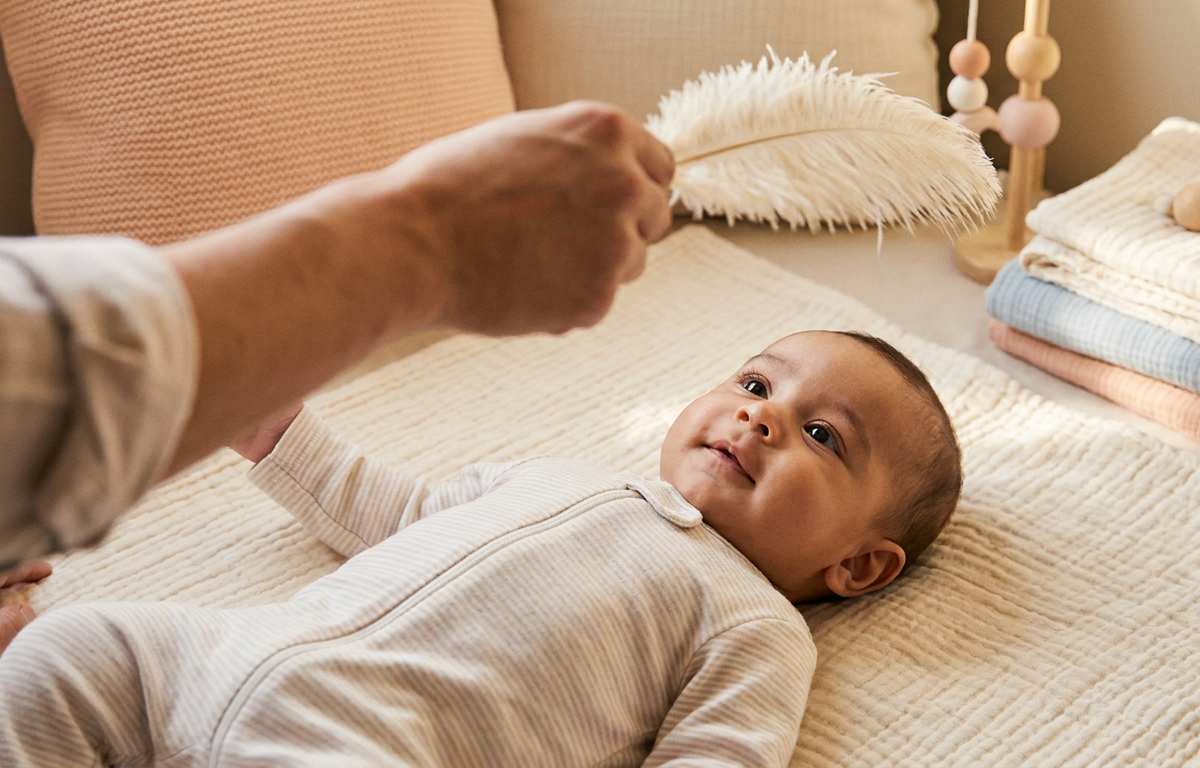
Help your baby discover the magic of gentle movement and practice keeping their eyes on a delightful dance.
Ready right now 5 min Ages 1–3 months 1–2 players Indoor
visual trackingattentioncause and effectfocusobject permanence
Materials
- large, soft feather1
Setup
- 1Find a quiet, calm space where your baby is comfortable, either lying on their back or propped in a bouncy seat facing you.
Step-by-step instructions
- Settle in beside your baby so you can see their eyes clearly, and hold the feather about 8–10 inches from their face — just far enough that they can take the whole thing in without going cross-eyed. Take a slow breath yourself; babies mirror our pace, and a calm start invites a longer, softer moment of attention.
- Begin with a gentle side-to-side wave, moving the feather at about the speed of a slow lullaby. Watch their eyes, not the feather — you'll see the tiny catch-up flicks as they learn to follow. If their gaze drifts, pause and bring the feather back to center to help them find it again.
- Pause for a beat at each end of the arc, like the feather is taking a little breath. These pauses give your baby's eye muscles the split second they need to lock on, and they turn the game from a blur into a real tracking practice.
- Once side-to-side feels easy, try slow up-and-down motions, then draw a soft, wide circle in the air. Change one direction at a time so the newness stays exciting instead of overwhelming — this is where visual coordination really starts to bloom.
- Narrate everything in a warm, sing-song voice: "There it goes… up, up, up… and now it's floating down." Your voice is half the magic here — it tells your baby this shared moment matters, and it wires language and vision together.
- Watch for the little signals that they're fully engaged: widened eyes, a quieter body, tiny mouth movements, maybe a coo. Celebrate those with a soft smile and a "you see it!" — the connection is the real learning.
- When you notice the yawn, the look-away, or the fussy squirm, that's their gentle way of saying "I'm full." End on a high note with one last slow pass and a snuggle, and tuck the feather somewhere safe for next time — this is a game you can return to daily as their tracking grows sharper week by week.
Example playthrough
"Baby Leo giggles softly as his dad waves a big blue feather from side to side. Leo's eyes, wide with curiosity, diligently track the feather's every sway. "You're such a good watcher, little man!" his dad coos, as Leo's head turns slightly to follow its graceful descent. He reaches out a tiny hand, batting playfully at the air as the feather dances just out of reach."
Variations
- ✨ Use a different soft, lightweight object, like a colorful scarf or a soft toy, to vary the visual experience.
- ✨ If your baby is comfortable, try doing this during tummy time to encourage head lifting and turning.
- ✨ Experiment with different background colors by placing a contrasting blanket behind the feather's path.
Learning benefits
- 💡 This play helps your baby develop visual coordination and attention as they follow a soft object's path.
Safety notes
- ⚠️ Ensure the feather is clean and securely held, as small parts could be a choking hazard if detached and put into the mouth. Active adult supervision is required.
Cleanup
- 🧹 No mess! Just put the feather away for next time.
From the community (0)

Loved it? Let other families know
Everything is optional — leave a star, a tip, a photo, or all three.
Loading your feedback…