Behavior & big feelingsFor: Toddler, Preschooler 4 min
Why does my toddler throw, dump and line things up?
Repetitive play urges are learning patterns called schemas. Here's how to channel them safely.
The short version
Notice the repeated play pattern, check the child's needs and offer a safe alternative when needed.
Start here: the basics
What it is
Play schemas are repeated patterns children use to explore how the world works — like throwing, dumping, lining up, wrapping, transporting or climbing. If your toddler keeps doing the same thing over and over, they may be following a schema.
Why it matters
Behavior that looks messy or frustrating is often a child testing ideas about cause and effect, space, gravity and order. Recognizing the pattern helps you offer a safe 'yes' — somewhere it is okay to throw, dump or line up — instead of only saying no.
What's happening at this age
Schemas are especially noticeable in toddlers and preschoolers, often from around 1 to 5 years, when children learn mostly through their bodies and senses. Schema theory is a helpful lens used by many early-years educators, not a diagnosis, so use it as a way to understand your child rather than a box to fit them in.
Words you might hear
- Trajectory:
- Interest in how things move — throwing, dropping, kicking.
- Transporting:
- Moving objects from place to place in bags, buckets or pockets.
- Enclosing / enveloping:
- Building borders, filling containers, wrapping or hiding things.
What's happening
If your toddler keeps emptying the same basket, it can be both fascinating and exhausting. You can welcome their curiosity while keeping a few clear, safe limits. Early-years educators use 'schemas' to describe recurring play patterns such as moving, filling or lining up objects. It is a descriptive framework, not a diagnosis or an AAP explanation for every behavior. Children may repeat actions because they are interesting or familiar. Check hunger, discomfort and other needs rather than assuming you know the reason.
Common schemas and safe swaps
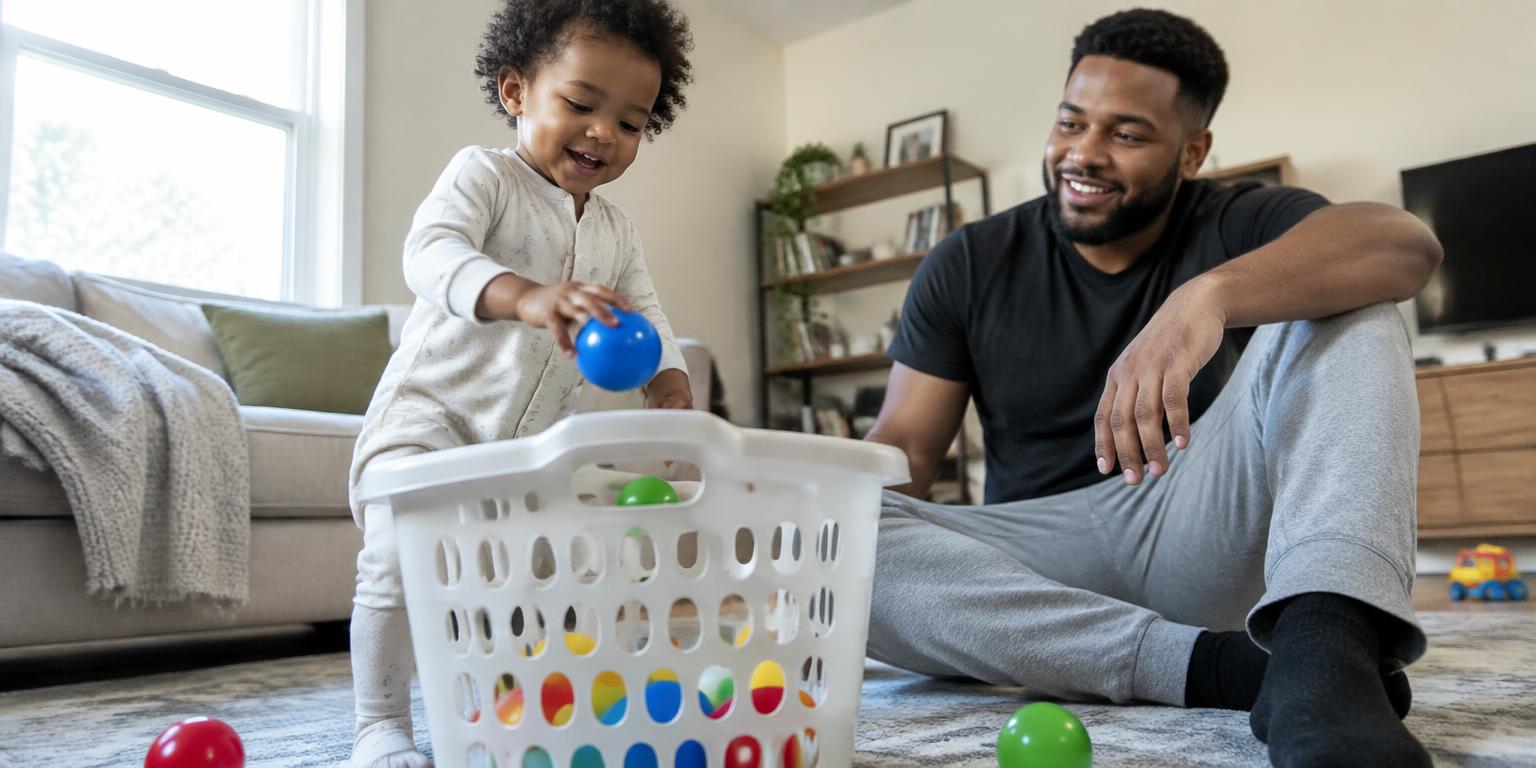
- Throwing (trajectory): offer soft balls and a laundry basket target.
- Carrying and moving (transporting): a bag or small wagon to fill and move.
- Filling and dumping (containing): sturdy cups and large, age-appropriate objects in a bin; avoid small loose pieces for children who mouth objects.
- Spinning (rotation): large age-appropriate rolling toys on a safe surface; keep loose parts inaccessible.
- Lining up (positioning): cars, blocks or spoons in rows.
- Hiding and uncovering: put a large toy behind a sturdy screen and find it together; keep fabric away from faces and necks and avoid places where a child could become trapped.
What to say
'Food stays on the table. You want to throw — let's throw these balls into the basket!' Name the rule, then give the yes.
Example play-through: dumping the basket again
Your two-year-old tips a basket of large blocks onto the floor, puts them back and tips them out again. You worry they are making a mess on purpose.
- Check the setting first: clear a safe floor area away from stairs and walking routes, and use large age-appropriate objects without choking hazards.
- Name the action without blame: ‘You are putting them in and tipping them out.’ Repetition may be interesting to your child; it does not tell you their motive or diagnose a play pattern.
- Set a concrete boundary: ‘These blocks can be tipped onto this mat. Food stays on the table.’ Move unsuitable items out of reach rather than repeating ‘Stop making a mess.’
- When play ends, join the cleanup: ‘I will hold the basket. Can you put in this block?’ Help with most of it if needed; do not expect a toddler to manage the whole reset alone.
If it is still hard: If the play becomes unsafe, stop the action and offer a safer version. Not every repeated behavior is a schema, and a play label should not replace assessment of developmental, sensory or safety concerns.
Example: emptying every drawer
Make household hazards inaccessible and provide a small container of safe, large objects to empty and refill together. Say, “Those drawers stay closed. This basket is for emptying.” Choose materials too large to choke on and suitable for the child’s abilities; small pom-poms, loose lids and torn pieces can be unsafe for children who mouth objects. Keep scarves away from faces and necks, and do not use enclosed boxes where a child could become trapped. A safe alternative still needs adult attention.
What schemas explain — and what they do not
Schemas are a descriptive early-years education framework, not an AAP diagnosis or a way to read a child’s brain from one behavior. Repetition can be normal, comforting or interesting without a label. Join the child’s interest and broaden play gently instead of stopping harmless patterns. Repetitive play alone does not diagnose a condition. If you are concerned about communication, participation, distress or loss of skills, ask the pediatrician rather than relying on a schema interpretation.
Try it with play
Plan these with Pip Plus
Quiet Time & Calm Corner
Stone Stack Stillness

Holidays & Seasons
Pumpkin Ring Toss Challenge

Holidays & Seasons
Pumpkin Patch Stackers

Life Skills
Laundry Color Sorting with Baskets

Games
Silent Ball Toss

Water Play