
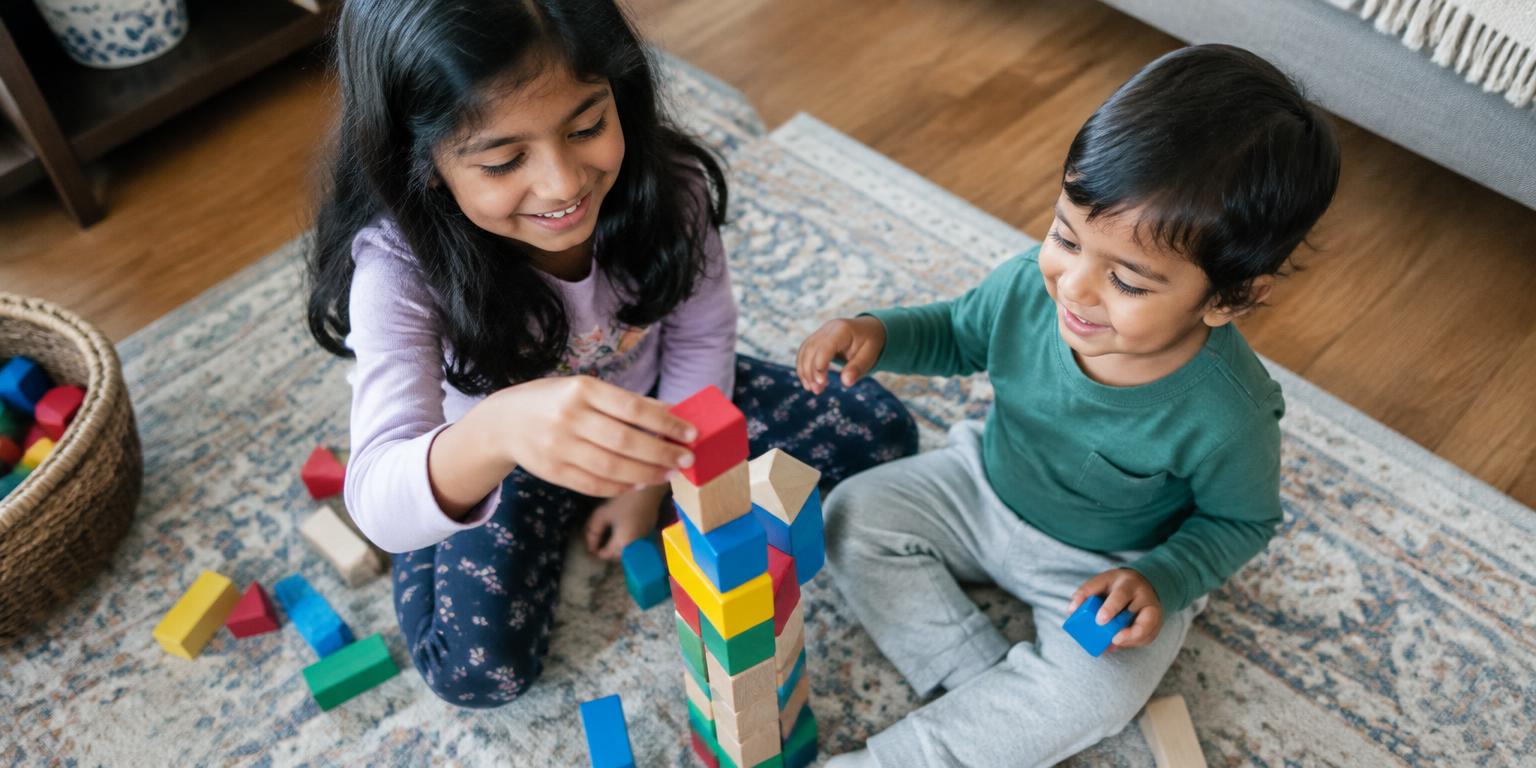
Siblings & multi-age playFor: Toddler, Preschooler, School-age 6 min
Sharing, turns and solving the “one toy” problem
Patient ways to practice turns, protect special belongings and make room for each child.
The short version
Turns are practiced with help; respect boundaries while making space for everyone.
Start here: the basics
What it is
This guide covers how children learn to share, wait and take turns with toys, space and attention.
Why it matters
Sharing is a skill that takes time, practice and a growing ability to understand others' feelings. Forcing sharing can lead to more conflict, while teaching turn-taking builds patience, fairness and friendship skills.
What's happening at this age
Toddlers are naturally focused on their own wants and often struggle to share. Preschoolers begin to take turns with support, and school-age children can negotiate more independently.
Words you might hear
- Turn-taking:
- Each person gets a full turn, then passes it on — often easier than splitting things.
What is happening — and what the evidence says
The “one toy, two children” moment is familiar in many homes. Taking turns is something children learn with help, not a kindness test they need to pass. AAP guidance describes increasing cooperation in preschool while acknowledging that sharing is still difficult. Toddlers often need close adult help because impulse control and language are still growing. Access to the same toy does not require instant sharing or forced affection. Timers and trades are practical options, not scientifically guaranteed solutions; choose a method children can understand and keep everyone safe.
What to try
- Stay close with younger children and describe the problem without blame: “Two children want one truck.” Stop grabbing or hitting safely.
- Model a request: “Can I have a turn when you finish?” Offer another activity while waiting; waiting may need adult support.
- If suitable, agree on a visible turn or timer. Do not abruptly use a timer to take a child’s project away; discuss it beforehand.
- Allow protected belongings and unfinished projects. Put away items that are not for shared play before a visit.
- Help older children propose a trade, different roles or a cooperative version. An adult should not expect the older sibling to always yield or care for the younger one.
Words you can use
“You are using it. Sam wants a turn. What could we do?” “That is your special project; we will keep it safe. These blocks are for everyone.”
A small practice for today
Try a short rolling-ball game with clear turns. Narrate “your turn, my turn” and end while it is still enjoyable. Expand the waiting time gradually, not as a test.
Example play-through: two children want the same truck
At home, three-year-old Maya is driving a shared truck along a block road. Five-year-old Leo reaches for it. Maya pulls it back and shouts, ‘Mine!’ Leo starts pushing her arm.
- Move close and stop the pushing gently: ‘I will not let you push. Maya is using the truck, and Leo wants a turn.’ Keep your voice brief and neutral; neither child needs a lecture.
- Help Leo make a request: ‘You can ask, “Can I have a turn when you finish?”’ He can use a gesture or your help instead of repeating the words. Tell Maya, ‘You do not need to hand it over in the middle of your road.’
- Make the next turn concrete. Ask Maya, ‘Would you like to finish this delivery, then let Leo drive?’ If she agrees, say to both, ‘After this delivery, Leo has a turn.’ A timer is an option only if you agree on it first, not a surprise deadline.
- Stay with Leo while he waits: ‘Waiting is hard. Would you like to build the garage with me or use this other vehicle?’ When the delivery ends, help with the handover. Notice the specific action: ‘You passed the truck gently.’
If it is still hard: If Maya is not ready to agree or Leo is too upset to wait, do not repeat the request louder. Separate play spaces and help each child settle; return to a shared plan later. A successful moment might simply be stopping the pushing. Leo being older does not mean he must always give way.
Example play-through: a special toy at a playdate
Before a friend arrives, four-year-old Sam says, ‘Nobody can touch my birthday dinosaur.’ You want the visit to feel welcoming without forcing Sam to give up a treasured belonging.
- Before the visit, say, ‘That dinosaur is special to you. Let us put it somewhere safe while your friend is here.’ Choose a place younger children cannot reach.
- Pick shared toys together: ‘These blocks and these cars are for both of you today.’ Help Sam understand which belongings are protected and which are available for joint play.
- If the friend asks for the dinosaur, answer without blaming Sam: ‘That one is put away today. You can choose a car or build with us.’ You handle the boundary so Sam does not have to defend it alone.
- If a dispute starts over the shared toys, describe the problem and help arrange a turn or different roles. Do not bring out the dinosaur as a reward for sharing.
If it is still hard: If the visit is becoming overwhelming, offer a supervised break or shorten it. Being hospitable does not require sharing every possession, and a difficult playdate is not a kindness test.
Example: a timer causes grabbing
A timer is not automatically fair if one child did not understand the agreement or the task needs a natural stopping point. Pause and agree in advance: “When the truck finishes this road, it will be Sam’s turn.” If the wait is too long for a toddler, provide an alternative and adult help. Never expect another child to absorb hitting while they wait. For older children, ask them to propose a trade or separate roles; you remain responsible for stopping harm, not for finding an identical solution every time.
Teach the request and the response
Practice both “May I have a turn when you finish?” and “I am using it; you can have it next.” Accepting a reasonable no is part of social learning, just as noticing another child’s interest is. Before visitors arrive, put treasured belongings away and choose toys intended for shared use. Do not force affection or use humiliation to enforce “kindness.” If turns consistently overwhelm a child, shorten the game and adapt communication or waiting demands rather than making them prove patience.
Try it with play
Plan these with Pip Plus
Holidays & Seasons
Langar at Home: Share-a-Meal Seva

On-the-Go & Waiting
Silent Sibling Semaphore

Water Play
Water Balloon Partner Toss

Toddler (12–36 months)
Turn-Taking Ball Roll Circle

Parent Care
Fifteen-Minute Daily Download: Connecting with Your Partner

Parent Care