
Health, sleep & safetyFor: Baby, Toddler 4 min
Safe sleep and baby sleep struggles
The AAP's safe-sleep ABCs, plus gentle help for night wakings and regressions.
The short version
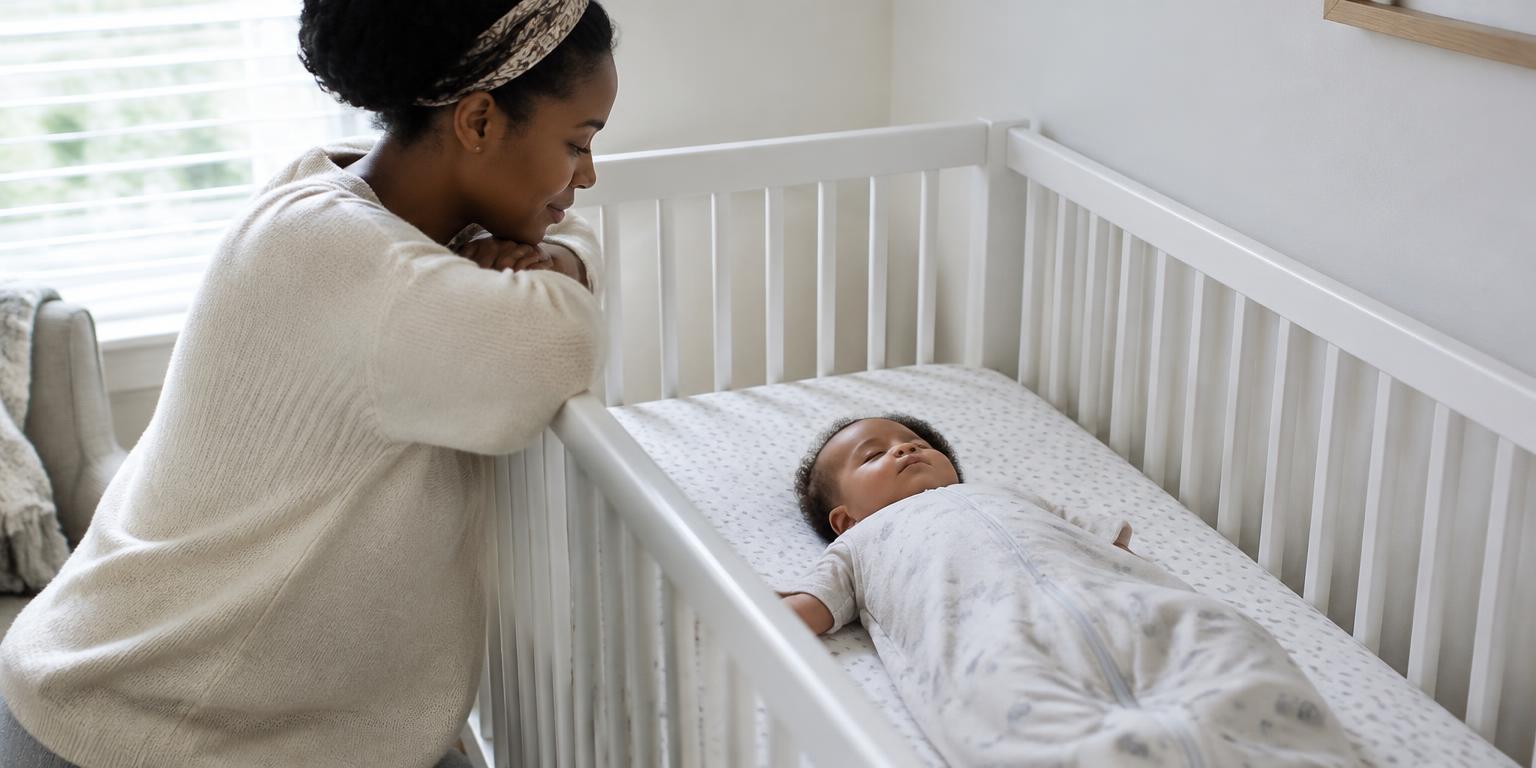
For every infant sleep: start on the back in a separate, approved crib, bassinet or play yard with a firm, flat mattress and fitted sheet only.
Start here: the basics
What it is
Safe sleep means setting up your baby's sleep in the way research shows lowers the risk of sudden infant death and suffocation: on their back, on a firm flat surface, in their own crib or bassinet, with nothing else in the sleep space.
Why it matters
Babies cannot easily move away from soft bedding or turn their face to breathe freely, so the setup does the protecting for them. Sleep struggles are also one of the most exhausting parts of early parenting, so this guide pairs safety with gentle, realistic ways to cope with night waking.
What's happening at this age
The AAP recommends back-to-sleep for every sleep until your baby's first birthday, and room-sharing (not bed-sharing) ideally for at least the first six months. Newborns wake often to feed — that is normal and healthy, not a sleep problem. Longer stretches usually come gradually over months, and every baby's timeline is different.
Words you might hear
- SIDS:
- Sudden Infant Death Syndrome — the unexplained death of a baby during sleep. Safe sleep practices lower the risk.
- Room-sharing:
- Your baby sleeps in their own crib or bassinet in your room, close but on a separate surface.
AAP safe-sleep basics
Broken nights can be exhausting, and it is understandable to want something that helps. A simple, safe sleep space remains important even on the hardest nights. Ask for practical help with rest where you can; you do not have to manage exhaustion alone.
- Place babies on their back for every sleep until their first birthday.
- Use a firm, flat mattress with a fitted sheet only — no pillows, bumpers, blankets or toys.
- Room-share without bed-sharing, ideally for at least the first 6 months.
- Avoid inclined sleepers, car seats or swings for routine sleep, and weighted sleep sacks.
- Offer a pacifier at sleep time once breastfeeding is established.
- Keep baby's space smoke-free and avoid overheating.
When sleep changes
Sleep patterns change and there is no predictable schedule for 'regressions.' Feeding needs, illness, environment and development may all matter. A short, familiar routine can help make evenings predictable, but cannot guarantee uninterrupted sleep. Ask about persistent concerns rather than adding sleep products.
For toddlers
- Keep the same bedtime and wake time, even on weekends.
- Turn screens off at least an hour before bed.
- Ask the clinician about age-appropriate comfort items and individual risks; a first birthday is not automatic clearance for every soft object.
Example play-through: you feel sleepy during a feed
It is late at night. You are feeding your young baby and notice your eyes closing. You are tempted to move to the sofa so you can both get comfortable.
- Recognize the risk immediately: sofas and armchairs are particularly dangerous places to fall asleep with a baby. Do not move there to rest together.
- If a capable trusted adult is available, ask directly for help: ‘I am getting sleepy. Can you stay awake with me and help return the baby to the crib?’ Do not assume someone nearby is already supervising.
- Return the baby to their own firm, flat, approved sleep surface on their back, with only a fitted sheet. Keep pillows, loose blankets, toys and positioners out; room-sharing does not mean sharing the adult bed.
- If you need to pause the feed because you cannot stay awake safely, place the baby safely in the crib and get help. Discuss ongoing night-feeding and exhaustion challenges with your care team rather than improvising a new sleep surface.
If it is still hard: If you accidentally fall asleep while feeding in an adult bed, move the baby to their own safe sleep space as soon as you wake. Bed-sharing is not recommended. Ongoing difficulty coping safely deserves practical support; you do not have to solve exhaustion alone.
Example: the exhausted adult at a night feed
Before feeding, think about where the baby will sleep afterwards and who can help if you are very sleepy. Do not feed on a sofa or armchair if you might fall asleep there; sleeping with a baby in those places is especially dangerous. The AAP recommends a separate infant sleep space and does not recommend bed-sharing. Ask for practical help with the night routine rather than treating exhaustion as a willpower problem. A safe-sleep plan should be shared with every caregiver, including relatives who used different practices in the past.
Help with sleep without adding unsafe products
A calm routine can make evenings predictable, but it will not eliminate normal waking. Avoid assuming every change is a developmental “regression”; illness, feeding and the environment may matter. Do not add weighted items, positioners or loose comfort objects to an infant’s sleep area to solve waking. As a child grows, ask the clinician about age-appropriate bedding and any individual risks instead of treating the first birthday as automatic clearance for every object. Seek help promptly for breathing concerns or unusual difficulty waking.
Try it with play
Plan these with Pip Plus
Quiet Time & Calm Corner
Slow Motion Puppet Bedtime

Quiet Time & Calm Corner
Bedtime Body Nightlight

Baby (0–12 months)
Bath Time Storyteller

Parent Care
New-Parent Sleep Hygiene Basics

Baby (0–12 months)
Cozy Bedtime Routine

Baby (0–12 months)